Pulling its weight: The real job of a service-based brand
For small service providers wearing a thousand hats every day, your brand is the secret weapon that establishes your authority, expertise, and what it’s like to work with you before clients ever send that inquiry or book a sales call.
When it’s doing that job well, you get the freedom to stay focused on your zone of genius. But when it’s not pulling its weight, the burden falls back on your shoulders — leaving money on the table and you frustrated and stretched thin.
I work with a lot of consultants, creatives, and practitioners — all experts who make a living by combining their knowledge, experience, perspective, and values into truly unique, exceptional experiences for their clients. They know their stuff. They’re brilliant at what they do.
And yet they find themselves doing all the work the brand should be doing for them: selling, explaining, educating, building their authority, filtering out the poor-fit clients and getting their dream clients excited to start working with them.
We need to flip that on its head. Here’s how.
The real job of an expert service provider’s brand
Your brand isn't just a polished highlight reel. It's an extension of your knowledge, expertise, and values that works on your behalf when you’re not in the room to showcase the experience clients can expect when they choose you.
When your brand presents a less compelling or more confusing version of the real you, you don’t just have a brand problem. You have a business problem: you’re losing people and leaving money on the table. People are confused, so they may not reach out right away — or when they do, they may not be the right fit. It’s a recipe for frustration and inefficiency, and a roadblock to your growth.
And it’s not just about polish. A beautiful brand, if it’s sending the wrong message, is simply not doing its job.
The real job of an expert service provider’s brand is to capture the essence of what you want to be known for (your expertise and zone of genius) and extend that into every interaction with your clients and prospective clients, creating a consistently magnetic experience that mirrors what it’s like to actually work with you.
Case study: Launching a brand that made growth easy
Here's an example of what it looks like when your brand is doing the heavy lifting for you. A client I worked with a couple of years ago was starting a brand-new counselling business. She wanted two things:
Make the brand look established from the very beginning, showcasing her expertise and communicating her values and approach to the people who would be the best fit for her.
Take the burden of selling and educating off her plate so that by the time people reached out, they already had the information they needed and knew what it felt like to work with her. All she had to do was get them onboarded and start the process.
We kept the project really focused. We established her strategy with a Brand Blueprint, then created a simple but beautiful brand identity that was meaningful, personal, and totally in line with her approach to counselling. I worked with her on the messaging and we built a very simple Squarespace website that she could manage and update herself.
And it worked! Her mentor had told her to expect it to take about a year and a half to be booked out, but she did it in six months — a third of the time. And while timing worked in her favour (it was the middle of COVID and there was a lot of demand) that demand was only half the battle. The fact that she hit the market at the right time with a brand that was equipped and ready to meet that need was lightning in a bottle for her growth.
Reinforcing your expertise and authority: How a service-based brand gets results
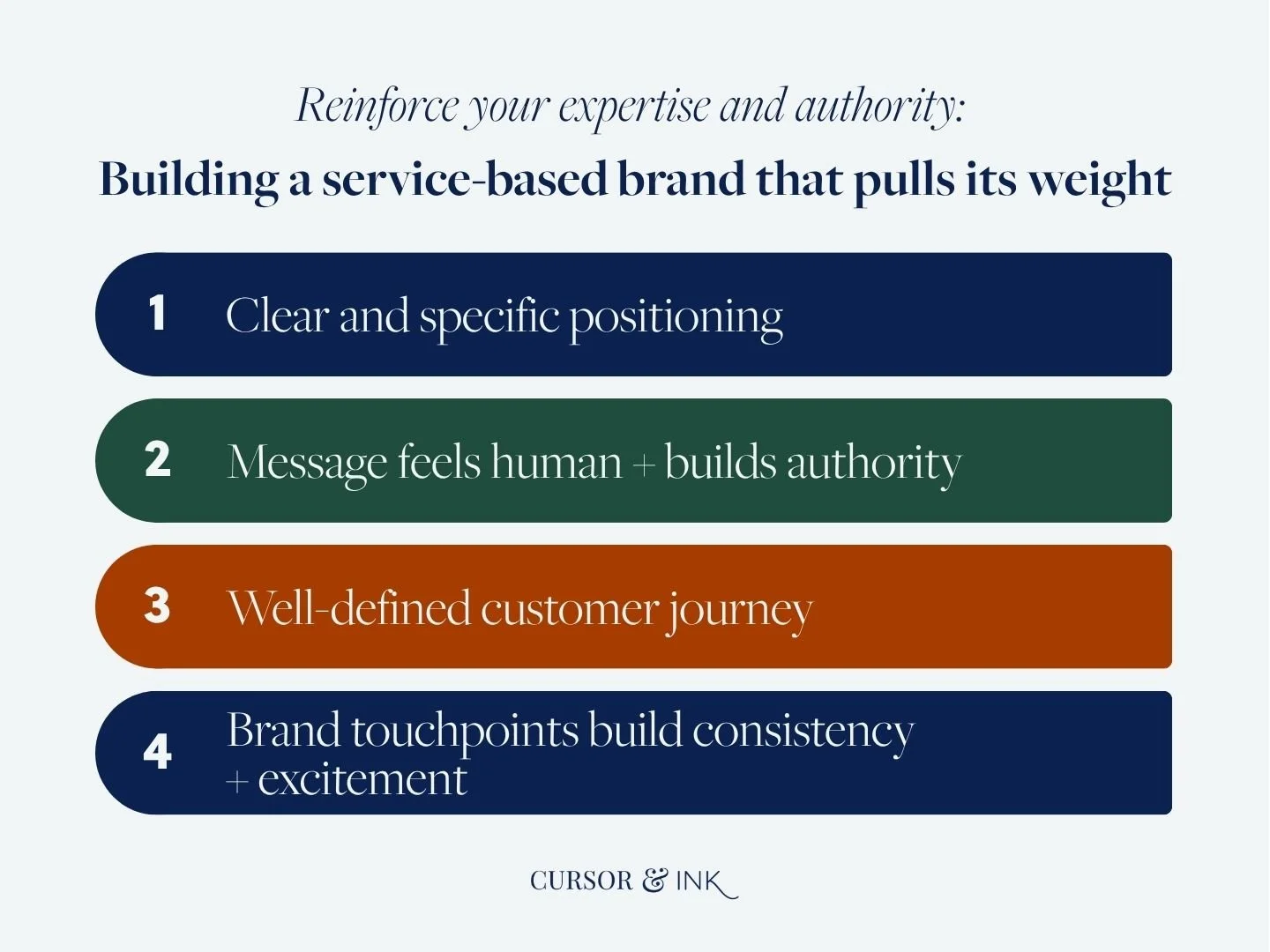
So what do you need to build a brand that reinforces your expertise and becomes an engine for growth in your business?
The key is to blend strategic foundations, a strong message, and consistent execution. This is what gives your brand depth and nuance. It’s how you build something that feels like a true extension of your heart, your voice, your values, how you work, and why that matters.
(It’s also the heart of my Elevated Brand Ecosystem method, which focuses on taking a sustainable, long-term approach to building a premium service brand.)
Here’s what goes into an elevated, consistent brand presence that will work hard on your behalf:
Your positioning is clear and specific
Your positioning — where you sit in the market — means you can explain who you serve (and who you don’t) and what makes you different from everyone else. Specificity is important here, because it helps you to clearly communicate exactly what you do, who it’s for, and why it matters. It helps your audience understand why they should choose you over your competitors.
Along with your vision, mission, and values, positioning is a foundational part of your brand strategy. It anchors your messaging and directs all of the decisions you make in your design and marketing.
Your message feels human and builds authority
A lot of service providers’ messaging amounts to, "Here are the three things I do, book a call to get started." That’s fine if you’re crazy busy with referrals and aren’t too worried about your marketing strategy. But if you need your brand to do the selling and education for you, it’s probably not enough.
A premium brand experience is powered by messaging that builds a bridge between your expertise and the transformation you create for your clients. What will they get? Where will they be after working with you? How will they feel? How will their lives be better, easier, or more fulfilled?
A strong brand voice also makes a world of difference. When your brand voice is a reflection of how you talk and communicate, it:
Creates consistency with how you show up in person.
Feels unique and memorable instead of generic, vanilla, corporate, or everyone else in your industry.
Builds trust and connection by sounding personal, meaningful, and human.
Your message should also establish your authority as an expert. This is about a lot more than just qualifications — it’s also about lived experience, perspective, and the values that shape your approach. The question your messaging needs to answer is what makes you the right person for the job, not just a qualified one.
You’ve mapped out the customer journey
In marketing speak, the customer journey is mapping out the path your customers take from:
Finding you for the first time (discovery)
Getting to know you / thinking about buying from you (consideration)
Making the purchase (sale)
Working with you (delivery)
Staying in touch and spreading the word (retention & loyalty)
In human speak, it means meeting your customers where they’re at, at every stage of the journey. This means you’ve put some thought into what they’re thinking and feeling at each of those five stages and are able to meet their needs and provide value at that stage.
This does not need to be fancy. But it helps you decide how your brand should show up at each moment and create a consistent, authoritative, value-led experience that gives them what they need and helps them to take the next step. And that’s where your brand really starts to work overtime on your behalf.
Your brand touchpoints do the filtering for you — and build consistency and excitement
Brand touchpoints are all of the different places and ways your audience comes into contact with you. It’s the specific spots at each stage in the customer journey that you interact with your people, including:
Marketing: website, social feeds, guest podcast appearances, ads, brochures
Sales: pitch decks, proposals, pricing guides, contracts
Delivery: onboarding, guides, documents, videos, training
Post-engagement: offboarding, follow-ups
Our goal at this point is to treat each of these touchpoints as a chance to build authority, win over your ideal clients, and filter out the ones you don’t want to work with. Here are just a few examples of what that looks like:
Website copy that pre-qualifies people before they book a call.
Sales assets — proposals, pricing guides, process docs — that reinforce your expertise at every step.
An inquiry process that signals the kinds of clients you want to work with, so people are clear as they move through it.
Most importantly, you should see each of these touchpoints as a branding opportunity to create a sense of consistency around the experience you offer and build excitement — so your people can’t wait to work with you, to get in the room with you, to have your eyes and your input on the problem they're trying to solve.
Final thoughts
As a business owner, you're always going to wear a lot of hats. But a really effective, heavyweight brand that works for you is a member of your team. It's the first member of your team, in a lot of ways!
When you’ve built it out well, it will let you wear the hats you actually want to wear — the stuff you're best at, your true zone of genius — while providing the systems and support that allow your business to grow more sustainably.
Want a hand building this yourself? My Brand Alignment Scorecard is a great free way to see what’s working and where the opportunities are to strengthen your brand. And if you want my eyes on your brand so we can work through this in person, the Brand Strategy Roadmap is built exactly for this. Let’s get rid of the guesswork and build your brand to do the heavy lifting for you.